
 MsDressly
 MsDressly
Best Dress Styles to Hide a Stomach: A Flattering Fit Guide
Outfit guidance first — then one shoppable MsDressly piece with price and sizes below.
One in-stock pick to shop now
Shop Evening & Cocktail Dresses
Updated October 2026 by the MsDressly editorial team.
Shop the styles
-

Women's Halter Style Loose Irregular Dress for Casual Chic — $69.99 -

Women's Fashion Style Button Lantern Long Sleeve Blouse — $49.99 -

Women's Green Floral Puff Sleeve Buttoned Babydoll Dress with Southern Belle Style — $69.99 -

Women's Apricot Cheetah Print High Neck Short Sleeve Sweater - Southern Belle Style — $49.99 -

chic women's floral print long sleeve cotton shirt - casual and cozy fall fashion for effortless autumn style made for easy styling and wardrobe with — $39.99 -

Cozy Women's Western Print Sweatshirt - Soft Casual Style for Everyday Comfort and Effortless Chic Fashion — $39.99 -

cozy women's black sweatshirt dress - long sleeve, relaxed fit for effortless casual style and everyday comfort with practical styling and dependable — $69.99 -

Elegant Women's Black Long Sleeve Fit-and-Flare Mini Dress - Versatile Casual Style for Any Occasion made for easy styling and wardrobe coordination, — $119.99
Rethinking What It Means to Dress for Your Midsection
Searching for a dress that hides your stomach usually means you want one thing: a silhouette that skims the middle instead of spotlighting it. That is less about concealing and more about directing attention. The eye goes where a garment points it — toward a defined bust line, a graceful neckline, a swishy hem — and away from wherever the fabric simply floats.
Three mechanics do almost all the work. First, waist placement: a seam that sits just under the bust or well below the natural waist bypasses the fullest part of the midsection entirely. Second, volume distribution: a skirt that flares or drapes from a high point creates movement without gripping. Third, fabric behavior: structured or fluid fabrics hold their own shape instead of molding to yours.
Keep those three levers in mind and nearly every silhouette decision becomes easier — you are not hiding anything so much as choosing where the eye lands.
The Silhouettes That Work Beautifully
A handful of shapes consistently deliver because they were practically engineered around this exact concern.
- Empire waist: The seam sits directly under the bust and everything below falls free. It is the single most reliable cut for skimming the stomach.
- A-line: Fitted through the shoulders and bust, then widening gradually. The flare balances the middle without adding bulk.
- Wrap dress: The crossed bodice creates a V-neckline and gathers fabric diagonally across the torso — ruching by design. The tie can be positioned at your slimmest point.
- Fit-and-flare: A defined bodice releases into a full skirt, so the fabric never lies flat against the stomach.
- Shift and trapeze: Cut straight or tent-like from the shoulders, these skim everything between collarbone and hem. They shine in structured fabrics.
- Babydoll: The playful cousin of the empire waist — a high seam and a loose, gathered skirt that never touches the midsection.
Waist Placement: The Detail That Changes Everything
Two dresses can look nearly identical on a hanger and behave completely differently on the body — the difference is almost always where the waistline sits.
A seam placed at the natural waist (the narrowest point, usually near the navel) works well if your midsection fullness sits lower, but it can cut straight across a rounded stomach. An empire seam just under the bust moves the narrow point upward, where the ribcage is naturally slimmer, and lets fabric cascade from there. A dropped waist — a seam at the hip — does the opposite trick, elongating the torso and keeping the fitted portion away from the stomach.
Then there is the no-waist approach: shift and trapeze dresses that define nothing at all. When the fabric is crisp enough to stand away from the body, an undefined waist reads as intentional and modern rather than shapeless. The one placement to approach thoughtfully is a tight, elasticized band at the fullest part of the belly — it tends to create a dividing line exactly where you do not want one.
Necklines and Upper-Body Details That Redirect the Eye
Styling the midsection is as much about what happens above it as what covers it. Every detail near the face acts as a magnet for attention.
A V-neckline is the workhorse here — it lengthens the neck, opens the chest, and pulls the gaze vertically through the body rather than letting it settle sideways at the waist. Wrap dresses deliver this automatically. Halter and high-neck styles draw the eye up to the shoulders and collarbone. A scoop or square neck frames the face and exposes just enough skin to keep a looser dress from feeling shapeless.
Details near the shoulder and bust amplify the effect: puff sleeves add volume where it balances the silhouette, a decorative collar or button placket gives the eye a focal point, and embellishment or print concentrated at the bodice keeps interest high. Think of it as building a visual hierarchy — the more deliberate the top half, the more the bottom half simply flows.
Fabrics and Patterns That Skim Instead of Cling
Fabric choice quietly decides whether a silhouette succeeds. The friendliest options have body of their own — ponte knit, crepe, structured cotton, scuba, and lined chiffon drape over curves and hold a shape independent of what is underneath. Double-layered and blouson constructions add a floating top layer over a smoother base, which does the skimming work for you.
Very thin, slinky jerseys and satins tend to trace every contour, so reach for their textured or lined counterparts instead. And ruching — gathered fabric across the midsection — is the single most forgiving detail in dressmaking; it breaks up the surface so the eye reads texture, not shape.
With pattern, scale matters more than rules. Small-to-medium florals, vertical or diagonal prints, and ombré all keep the eye moving. Dark solid colors — black, navy, deep emerald, plum — recede visually, while a color-blocked dress with darker panels through the torso sculpts without a single seam of shapewear.
Lengths and Hemlines Worth Knowing
Hemline sets proportion, and proportion decides where the eye rests.
A midi hitting at mid-calf elongates the whole frame — especially effective on an empire or A-line cut, where the uninterrupted fall of fabric reads as one long line. A knee-length fit-and-flare gives you the same waist-slimming structure with more leg. A mini works best with volume: a straight-cut mini can pull attention toward the middle, while a flared or babydoll mini balances it with exposed legs.
Two underrated hems deserve mention. An irregular or asymmetric hem — handkerchief points, diagonal cuts, high-low shapes — breaks the silhouette into moving parts so no single area becomes a focal point. A maxi in a fluid fabric does the empire-waist trick at full length, ideal for evening and warm-weather events.
Whatever the length, the goal is the same: an unbroken vertical line somewhere in the outfit.
Layering Strategies for a Smooth Line
The right layer can do more for your midsection than the dress itself. The principle is simple: a long, open layer creates two strong vertical lines down the front of the body, framing a narrower column in between.
- Longline cardigan or duster: Open, hip-length-or-longer knits draw the eye up and down rather than side to side.
- Open blazer: Structured shoulders and a clean lapel line make the torso read as a column. Leave it unbuttoned.
- Cropped jacket — worn open: If it ends just below the bust, it mimics an empire seam and adds definition up top.
- Denim or utility jacket: A sturdy fabric layer smooths the transition between bodice and skirt.
One length to handle with care: a jacket or cardigan that ends exactly at the widest point of your stomach. It creates a horizontal break right there — size up to a hip-length or longer layer, or down to a true bolero, and the effect reverses.
Accessories That Pull Focus Upward
Accessories are the finishing move in directing attention — and a few placement rules make them work harder.
Statement earrings or a bold neckline-adjacent necklace keep the focus at face level. A long pendant does the opposite but equally useful job: it draws a vertical line through the torso, visually lengthening it. Either works — pick based on whether you want eyes up top or a lengthening line down the middle.
Belts deserve nuance. A wide belt cinched just under the bust reinforces an empire line beautifully. A thin belt slung low on the hips over a trapeze or shift adds shape without touching the stomach. The spot to skip is a tight belt at the natural waist over a clingy fabric.
Shoes finish the proportion: a nude or pointed-toe heel extends the leg line and supports the long, uninterrupted silhouette these dresses create. A structured handbag carried at shoulder or elbow height adds one more point of interest above the waist.
Styles That Deserve a Second Look
Rather than a list of things to cross off, here is a smarter way to think about the styles that get a bad reputation — each has a version that works.
- Love a bodycon shape? Try one in a heavier ponte or with ruching through the torso. Same figure-hugging spirit, completely different behavior across the stomach.
- Drawn to slip dresses? Look for bias-cut versions that flare from the bust, or layer a slim knit underneath for a smooth foundation.
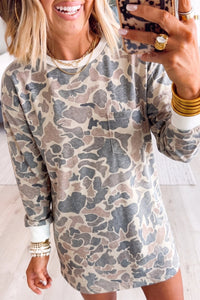
- Want a fitted knit dress? Ribbed or sweater knits in a relaxed (not painted-on) fit skim gracefully — a relaxed black sweatshirt dress is a perfect everyday example.
- Tempted by a peplum? Its flared panel was literally designed to drape over the midsection — just choose one where the flare starts above the belly.
- Prefer a straight shift? In a structured fabric it reads polished and architectural; add a statement neckline and it never feels shapeless.
There is no silhouette you must never wear — only versions of it that work harder for you.
Occasion Formulas That Just Work
Putting it together is easier as a formula. A few reliable combinations:
- Everyday casual: Relaxed sweatshirt or trapeze dress + white sneakers + long pendant necklace. Comfortable, unbroken vertical line, zero fuss.
- Work or dinner: Knee-length fit-and-flare in a dark solid + open structured blazer + pointed flats or low heels. The black long-sleeve fit-and-flare is built for exactly this.
- Wedding guest or event: Empire-waist midi or a wrap dress in crepe + heeled sandals + statement earrings. For a plus-size wedding guest look, the same rules scale perfectly — a raised waist seam, a fluid skirt, and a neckline that frames the face.
- Warm weather: Loose halter or babydoll dress — like the halter irregular-hem dress or the floral puff-sleeve babydoll — + wedges + a light open layer for evening.
Notice every formula uses the same three levers: waist placement, gentle volume, and one detail that pulls the eye up.
Shopping the Look
When you browse, filter mentally by construction rather than size label — seam position and fabric weight tell you more than a letter on a tag ever will. Look for product photos where the skirt visibly stands away from the body, descriptions that mention empire, wrap, babydoll, fit-and-flare, ruched, or relaxed fit, and fabrics listed as ponte, crepe, cotton, or lined chiffon.
If you are between sizes in a looser silhouette, choose the size that fits your shoulders and bust; the rest of the dress is designed to float anyway. That is the whole point of these cuts — the fit happens where you want attention, and the drape happens everywhere else.
Shop by category
Guides:Seasonal Capsule Wardrobe Systems: A MsDressly Guide · Budget Friendly Seasonal Wardrobe Planning: A MsDressly Guide


